Saturday, February 28, 2015

Three Things To Stop Doing and One To Do

While you're waiting for me to make some showable progress, do take the time to watch this short video from a gal who has quickly become a favorite of mine - how Angela Walters has such sage advice at this young age and in such a warm inviting way is beyond me! I particularly like her story about her quilting grandfather which reminded me a bit of my good friend LeAnn and her father back in Wisconsin. Enjoy! 


One of the reasons I don't have anything new to show is because I've spent the last few days pulling together what I needed to enter a couple of quilts in this year's Sacred Threads show. That included setting up properly to retake photos that were initially shot quickly in not the best lighting resulting in less than true colors.

I've wanted to have a quilt in this exhibit since its inception, but never quite coordinated a suitable quilt with the call for entries timeline. But with the making of Bubble Prayers - Release and Life's End, I've been waiting patiently for the next call, feeling strongly that I wanted to share these quilts in this venue.

I haven't felt the need to enter any kind of exhibit, juried or not, requiring hefty entry fees, really good photographs and shipping to faraway places since moving to Sandpoint, where I've found ample exhibiting opportunities through my local arts council. But this is different, this is a very special exhibit, and these are special quilts about a very special person. Crossing fingers one or both will make the cut.

Wednesday, February 25, 2015

Best Laid Plans

Still auditioning fabrics
Just when I think I have it figured out, I go second guessing my decisions. With all my interfacing pieces cut and ready for fabric to be fused, I began to waffle over which of those two dark fabrics should go in the middle, which on top. The batik was always the one fabric I was so sure of and now I wondered if it should be on top. I finally stopped myself, just go with what you originally felt strongly about. It never occurred to me that I didn't have enough fabric to cover that spot! Well - that made things a bit easier. As I studied the other Stonehenge fabric, I noticed that in some places the mottling definitely moves at an angle, much like the quilting I plan to do over it, so fate must be on my side here. I chose a spot where that showed up the most.


I'd wanted to make all the rest of the fabric choices now so I could do all the fusing at once, then do all the quilting at once, then do all the satin stitching at once. But I was still struggling to find the right piece to go in the lower right and bottom sections. I did end up purchasing more fabric but it occurred to me that I'd know better which was right once the quilting was on that center section. I could feel myself resisting working "out of order" but because of my out of the ordinary construction method, I can actually do this quite easily. I started marking the quilting lines, trying out a new product as my usual marking tools weren't showing. This chalk pencil by Roxanne seems to work well. I don't know what the binder is, but it does not brush off like other chalk-marking products I've used. I was a little concerned that the lines might disappear as I maneuvered the piece through the machine so perhaps this is good. Just so I can remove any visible marks after stitching, which I should be able to since it says it's water soluble. Yes, I should have tested first but I have a certain trust in Roxanne products. Fingers crossed that this does not become an issue somewhere down the line. By the way, these come in a 4 pack - 2 white, 2 grey. Does anyone have experience with these?


As I studied my sample as I worked, I suddenly remembered that this stitching I was marking would be emulating water flowing down over the stonework and I needed to satin stitch the grout lines first. After trying several settings, I settled on a 6 width and .8 length - it looks great!

Friday, February 20, 2015

Fun at the Art Group

Still seeking feedback on Adrift
My art group met earlier this week, minus Donna unfortunately (check out her Facebook page to see what she's been up to creatively). The day job has Mondays tied up for a bit so we were tasked with taking lots of pictures for her. I hauled out Adrift again along with some tree limb patterns from previous quilts I'd dug out of storage. Nothing is exactly right, and it's about time I bite the bullet and start sketching something specific for that space in the upper left. I did get one good observational suggestion from Meg's daughter (quite an artist in her own right and joining us because of the school holiday) about where to start the branch (lower along the side than I'd been thinking). The consensus though was I'll know better what to put in that corner once I work up the grasses and reeds along the lower right edge.

My 2007 Journal Quilts

Meg had mentioned an interest in pairing inspirational quotations with some of her art quilts which reminded me of the year's worth of journal quilts I did using quotations from a calendar as a prompt. This was back in 2007 and each month also was a challenge to try a new technique. I'd forgotten that I'd done so much thread sketching and thread painting that year, and had to think hard on some of them as to how I'd proceeded. Because of my penchant for record keeping, each quilt has info about technique and process printed on the backing like a huge label. So I could read off the quotation from the back as the girls viewed the front and scan for answers to their questions rather than try to dredge it up from my faulty memory.

Meg's latest birds and some feathers

Meg continues to work on her "quirkies" - essentially stand alone appliques that go directly on the wall rather than on a background fabric. Currently she is playing with feathers for a commission and continuing to develop bird images, having figured out a single body shape that can become different poses depending on where the wings, tail, beak and eyes are placed. Some of these may end up in the branches of a large quirkie tree she's working on. See this blog post for a peak at her process.


Most of the birds have wire legs/feet. I'm particularly partial to this one with beads strung on the wire legs.


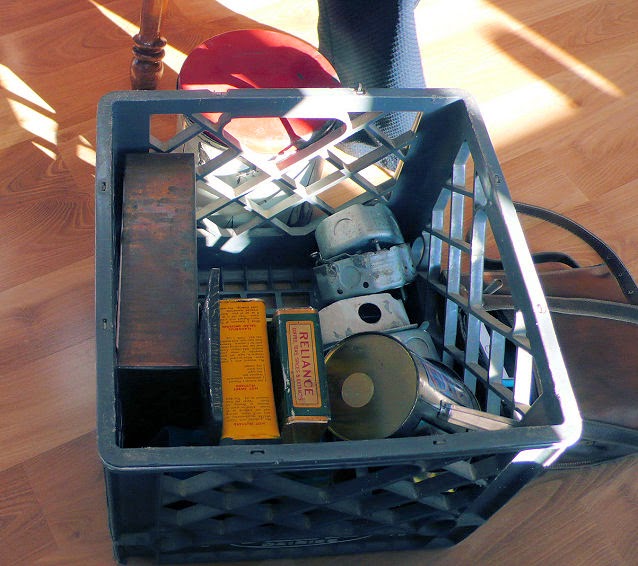
Robin wowed us with her collections of metal tins, canisters, and other odds and ends found at garage sales and building supply resale stores. 


She was looking for ideas of how to arrange them somewhat collage style within that copper square. So many of the same principles one applies to fiberart, we decided, to be applied here, even though we don't have the slightest notion of the mechanics of doing it! But Robin has a good eye and loves working with unconventional materials in a trial and error way.


She's got a great eye for working with fabric as well. We'd seen this small wall quilt at the last meeting and answered some of her questions about the netting she wanted to put over the top to trap some tiny snippets here and there. 


Now it is all stitched and a really stunning little art quilt.

So proud and grateful to have these ladies as friends and artist support.

Wednesday, February 11, 2015

Creating a Road Map

I've decided to set Adrift aside for the moment (more mulling and perhaps a burst of inspiration needed to "cowabunga" into the next stage) and get back to the fountain wall. After all, I've worked out most of the technical issues on the sample and have the full-size pattern drawn out. The big pattern plus all the fabric laid out in the auditioning process are taking up a full 3/4 of my work space. Time to start cutting and fusing.

But I can't just start cutting the interfacing following lines on my pattern. Some of those pieces overlap others. And some of the lines are actually stitching lines. Time to start measuring and making notes. Right away, I realized it would be helpful to color each unit to more easily see where the divisions are. On a whim, I'd bought a set of crayons and never used them; now they seemed the perfect thing to quickly shade in the sections. Next I numbered each section, noted whether or not I had to add overlap to the measurements, then measured away. Horizontal and vertical measurements are written in each section plus transferred to the number list on the left for quicker reference.

Then I drew the outline of each section with pencil onto the Stiff Stuff interfacing that will be the bones of this quilt. Overly cautious, you ask? I thought so, but if nothing else, I wanted to be able to change the layout should I find my first go didn't fit the amount of interfacing I'd bought. What actually happened was I'd made mistakes in transferring measurements to the list, and in one measurement itself. Yes, after drawing all the sections, I went back and double checked all measurements finding one huge one (2 inches short) and several small ones. After re-drawing some lines and triple checking, I'm fairly confident all is correct and I can proceed to cutting. I am SO glad I created a road map to work from.

The next step will be fusing fabric to these pieces of interfacing. I had planned to use Misty Fuse, even though I am not a big fan, and don't find it easy to use. But I have quite a bit of it and the wide widths may come in handy. It worked fine on the sample but now I am worried about the large sections which will have no stitching on them. One of the things I had problems with on other projects was the Misty Fuse lifting in spots, regardless of how well I'd ironed it down. Now I'm wondering if it might pop loose from unstitched areas as big as 21 x 9. If you're a big user of Misty Fuse, I'd appreciate your input on this.

Since the fountain wall idea is part of what got me thinking about doing a water series, I thought it appropriate to use this post to send you over to Annabel Rainbow's blog post about working in a series. She says pretty much everything I would say about it, and perhaps better. I particularly liked her mentioning that working in a series is not doing the same thing over and over, and it certainly is not boring. Go check it out: 

http://annabelrainbow.blogspot.com/2015/02/working-in-series-some-thoughts.html

Sunday, February 08, 2015

Degrees of Wonderfulness

Under consideration for rendering grass & reeds
I stopped by an artist friend's house the other day, Adrift in tow. I'd offered to let her try out some fabric markers I had on hand and she'd offered to let me raid her stash of decorative threads and yarns. She'd seen my last blog post on Adrift so knew where I was at in the questioning department. But nothing takes the place of seeing something in person, especially when in need of an opinion and perhaps an idea or two. I had questions about my perspective reference elements beyond "do you have better yarns than I do to represent grass" and could best talk about them with the quilt in front of us. I left still not sure exactly how I will treat these areas, but as I had hoped, my mind got a little unstuck and I got some good feedback. As my friend said, sometimes it just helps to talk these things through out loud, regardless of whether you come to specific conclusions.

In the course of this discussion about my quilt, we talked a bit about difference in designing styles. In this case, the design inspiration started with that shibori fabric; it's often a piece of fabric that sparks ideas for me. I remembered those unused leaves in a bin and thought aha! Perfect for making this idea of the water shibori complete. But of course, it was not complete and I didn't know what to add. Much later, I came across the hand-dye and thought aha! Add that to the top and the design is complete. But once I started quilting, I realized it was not complete, it needed more. And that is where I'm at right now. I realize that if I finished it up with no more additions or fiddling, many people would say how wonderful and beautiful it is. But I would know it needs more.

And so in this talking it through, I discovered a bit more about myself and my way of designing and looking at other quilts. I realized that I very often go through three stages:
  1. Most people think it's wonderful just the way it is. Perhaps it IS wonderful on some level, but I know it is not truly wonderful.
  2. I think and think and mull and study and suddenly, aha! I'm onto something and I start moving forward on the work. Again, I find many people would find it wonderful at this stage too, but I'm still bugged by something. I know it is not as wonderful as it could be.
  3. I finally have that breakthrough moment, where the "I'm on to something" becomes "I know what that something is" and I can/do make it happen. Now the quilt is truly wonderful, something special, and I am happy.
Believe me, every quilt I finish does not achieve the third stage status, try as I might. Some concepts start out well but are beyond what I can figure out, or I'm under time constraints that don't allow me to continue pursuing the "onto something" until I fully realize it. That's part of the learning curve, like it or not (and often I do not!).  Adrift is at that I'm on to something stage and I'm having a difficult time grabbing on to what that something is! But I sense I am close.

As if to confirm this insight and make me feel better about my plight, the very next day I ran across a similar thought voiced by painter Nicholas Raynold in an interview with The Artist's Magazine. Among the fundamental principles that he feels will help students when they run into trouble while developing their pictures, he includes letting the painting evolve.
"The construction of a painting evolves, in the same way our understanding of seeing deepens as we become more familiar with a subject; the picture advances from crude to refined, from dull to brilliant, from simple to complex."

A part of that evolution I would say is another of his principles: thinking through problems.

"If you feel that something isn't right, don't just hack away at it. Stand back, think it through and try to resolve whatever it is."

Also pertinent to my discussion with my friend, where I admitted that I felt the need to look at pictures of grasses to be reminded how they bend and entwine, the principle of trusting eyes over memory.

"Don't trust that you'll remember the intricacies of a line or brushstroke."

And you should not be surprised that I like that he stresses the benefits of slowing down in the last section titled "Slow is Good", favoring accuracy over speed and the importance of solid observational skills. 

"Always be attentive to what you're doing..."

Some of the advice in this article (May 2014 issue) is geared to students participating in a workshop situation as is this next quotation. Still, I think it a good one to take home to the studio.

"Everyone is at a different place in his or her painting career. Each has a different set of problems to resolve. Workshops last a limited time, so if you grasp just one sliver of illumination that moves the struggle forward - then you've achieved success."

Thursday, February 05, 2015

Analogous

View of quilting taken from an angle
I finished the quilting on the shibori piece, mostly pleased but not at all sure I sent my lines the right direction in that section on the left butting up against the red in the upper center. The fabric will not respond kindly to picking out and restitching so I am stuck with it. However, I've been considering adding some branches along the top as a perspective reference and most recently have thought to put them on the left. That's what that little sprig of threadwork over tulle is all about. Certainly not the right size, but it's got me thinking about stitching up a larger spray to emulate perhaps a cedar branch. It would be fortuitous if its placement helped distract from a distracting piece of quilting.

Struggling for a decent leaf arrangement

I've been calling this "the shibori piece" for so long that I nearly forgot my original inspiration and name. After fully quilted, I meant to add these 3-dimensional leaves as if floating on the water, which spawned the name "Adrift". Guess I've gotten a little adrift myself over the months since starting it. I just pinned these on to get them on the quilt so I could further consider additional references. You can see a bit of yarn in the lower right corner - I'm wondering if I can use them to make grass or reeds in the foreground. I like the balance I think I would get from those two reference elements being in opposite corners with the water obviously flowing from the other direction between them. But I'm not at all happy with the current placement of the leaves. Suggestions welcome.

Painting swaths of analogous colors with the help of scalloped cardstock

So what has this to do with "Analogous"? With this quilting done, I've returned to the art journaling. My next lesson in Creating Art At the Speed of Life is one on analogous colors; pick a favorite color and the colors on either side on the color wheel and watercolor paint those across the page. I was tempted to work with my often default teal (blue-green) but I've been using that combination a lot lately in the journaling. Let's pick something else I'm drawn to and work with all the time. Oh yeah - orange in all its autumn rusty golden glory. Like that "guava" dye run and the one-off piece with the same dye colors from my last dye session. And like the fabrics in "Adrift" that I'd just been working with. Funny how I've never consciously thought in terms of their position on the color wheel when choosing to work with this grouping of yellow-orange/orange/red-orange. I just knew they felt so right together, very natural.

There's more to add to this page, of course, but while it was drying, I switched to the other journal, searching through my newly started stash of art journaling materials for pictures to arrange on that purplish spread before adding my responses to the prompt. I'd forgotten I'd pulled the scene below from a magazine and stashed it there, but it confirmed my draw to this analogous grouping and how well it works. Analogous on the brain and not even aware of it!


I'm remembering now one of the reasons I decided to buy Pam's book and work through it. You see it in the picture above - a little self-critique form. "Rah Rah" and "Everything you do is wonderful" support only gets you so far. At some point, if you want to improve, you have to be honest and put a critical eye to what you have done. Pam doesn't want you to just play and explore and create a beautiful little art journal. No, she wants you to play and explore and then assess what you have done - the good, the bad and the ugly. And also think about how you could apply what you have just done to your regular work, something I'm often unclear about, although the doing might have been fun. And I so appreciate that. Yes, I'm often hard on myself, and in time can admit something might not be as bad as I initially thought. But dang it, don't whitewash it to spare my delicate feelings. (Yes, that was a bit of a rant.)

I'm slightly disappointed that there is not more specific instruction in how to use some of the supplies, like the watercolor paints. Total novice here and was unsure what was meant in the mixing directions. I've since done the inevitable google search and see where I went wrong. I guess for art journalers, they already know these basics, like I know how to use a sewing machine? And now that I've tried this analogous exercise, I can see I need a lot more experiment and play with them (practice), and perhaps some better quality paints. On the other hand, I'm just doing exercises in a workbook, not thinking of become a watercolor artist. Gotta keep this in perspective! 

Friday, January 30, 2015

Getting Back To It

For reasons I won't bore you with, I've not sat at the sewing machine since the beginning of the month when I whipped out that gift padfolio. Certainly no art quilting going on, until yesterday. To say there hasn't been a bit of quilt intimidation going on would be disingenuous, but there's been more than that - again, won't bore you. Just feeling some thankfulness that a fog lifted and I was actually eager to sit down with the shibori piece again.


I'd stopped after quilting the bottom section, pondering what sort of lines to add to the top and in what colors to make that section look like foliage. I'd hit upon the idea of contour stitching, and yesterday I was willing to give it a go. Because in the past I've gotten lost following along the natural patterning of some of my hand-dyed pieces, I took the time to really study what was going on in there and where the various divisions should be. I penciled the outline of each section as I went, the echoing lines not marked but stitched by eye. This made things much less overwhelming.


I soon discovered that I did not have to choose between the various threads I'd been auditioning, because each section called for its own slight variation (the colors in the above photo are the closest although still showing more blue than is in the blue/green section). Two different variegated greens, two different variegated red/yellows, a solid cinnamon and a final variegated incorporating the previous colors. So far so good.


Several people have said they do not see the trees and bushes that I do in that top section of hand-dyed, which is fine. That is what I feel my strength is, pulling out these images mostly with thread so that others can more easily see it. Can you see that far bank of foliage emerging now? Apologies for the very blurry picture. Probably not worthwhile to click on it for a closer look but do check out the larger versions of the others. 

Sunday, January 25, 2015

Journaling

Last week was a bit of this and that, but not much particularly fiber related. So my apologies to those readers who may not be much interested in my play with paper and paint. I'll soon be back to fabric and thread. But this is the why of the art journaling: to learn some basic things about color and design that my play with fabric so far has not entirely taught me. Now it is true that I was introduced to the color wheel a long time ago. That bit of knowledge unlocked a key to a more logical way to sort my growing fabric stash. But actually MAKE a color wheel to hang in my studio? Bah! Who needs that? I can always pull one of many books on my shelves that already have one included. But here I am, lesson one in the art journaling book and I must make a color wheel with watercolor paints. It was quite frustrating blending the primary colors to come up with the rest, painted onto a coffee filter and allowed to bleed into the adjacent segments. Doubly frustrating when I adhered it to the first page painted with an acrylic "glaze" of blue which shadowed through the thin filter, altering most of the colors there. But at least I have the names written in so it will be a reference even if the colors are not very true.


As long as the paints were going to be out which inevitably leads to excess paint on brushes or palettes, I decided this was as good a time as any to restart my Positively Creative Art Journaling exercises. I completed 18 of them before dropping the weekly practice that was to take me through the year. I've been wanting to get back to it, so took this opportunity to at least prepare some page spreads. As luck would have it, both journaling lessons included pouncing through stencils so I used a bit of each kind in each journal. For the Positively Creative journal spread, I expended the sponge with the blue glaze over the page. The yellow was left over from a bit of stenciling on the color wheel journal page. I'd watered it down a bit too much so the shape of the commercial stencil openings didn't show through but I got marks anyway. To stencil on the above page, the instructions were to basically cut a paper snowflake like when you were a kid. Well, apparently I was a kid not that long ago because I knew I had some small snowflakes of construction paper hiding away in my supplies. I pounced white paint over them, then flipped them over onto the color wheel page to transfer that excess paint. I liked that a lot. I still wasn't crazy about this journal page though, so added a very thin layer of the blue to help blend it all together. The journaling prompt was about three things you would grab if your house was on fire. I realized after inking the prompt on and using some yellow, orange and red sharpies to draw flames along the bottom, those white areas of the snowflakes looked a bit like ashes - I'd unintentionally prepared a fiery background for my journaling.

 
Back to Creating Art at the Speed of Life - the next lesson is on the facing page, starting with the same acrylic glaze and then dividing the page up into random boxes using the water soluble graphite pencils. All the words were provided in a list which included what they mean. I have to admit, I'd never heard of Achromatic and had to double check the meaning of several others. These should all be second nature to me but they are not. Doodling was encouraged; in fact, there were to be more boxes than words so that there would be empty ones to doodle in. I fell back on my Zentangling for ideas, making this the favorite part of the exercise. Then the instructions said to use the water soluble colored pencils to color in next to the outline of the boxes, matching colors to words if possible. The picture above shows the completed page prior to water activation.


Learning more about these pencils, again being reminded that it is not as easy as it sounds once the wet brush comes out. The pigment really moved over the acrylic, sometimes disappearing altogether - I'm guessing up into the brush. So I took more to patting with the wet brush, then maybe moving it back and forth a little more in certain areas. I suppose some of the disappearing act may have been due to the lightness with which I applied some of the colors. Some areas blended nicely, others show a sharper edge to where the color stops. One thing for sure, as soon as they were dry, there was no more blending to be had.


I thought I was done only to go to the next page of instructions and see that the white gel pen needed to be found. The suggestion was to add highlights of the white, visually taking it back to the original page color, and adding interest. I was surprised at how much difference this made with just the first few dots of white I added, so I added more until they were in all parts of the page.


The other thing that got through my brain by doing is that these pencils are transparent colors and just as affected by the color of the page underneath as the watercolor paints on the coffee filter were. The color over those spirals around the word "warm" started out yellow, but once the pigment was activated, the blue underneath makes them look green.


The next spread in the Positively Creative journal started with the sponging of the blue glaze left from preparing the other journal's word page. The yellow was added by flipping the commercial stencil that had been used on the color wheel page, the paint left on it after the pouncing being transferred to the awaiting page. It was still pretty light, the original text on the page not very covered up, so I sponged on some violet mixed with white. I think it looks better in person than I could get it to read in a photo and I'm looking forward to journaling over it.

Actually, I have to say that my limited experimentation with art journaling usually leaves me frustrated and disappointed with the outcome of the underlying page, and sometimes of the final outcome as well. It is only with a little time and distance that I warm to my efforts. These pages of this week were no different, leaving me wondering why I keep coming back to this, why I keep hoping for a different outcome, what exactly is the point of spending my time this way. I think I knew the answer deep down but it was made clear in this passage from the January 2015 Smithsonian Magazine article about the American Indian practice of pictographic calendars - the recording of each year with just two of the most important events - one for summer and one for winter.

"One can imagine the unidentified artist setting his task. The questions he faces on the blank sheet of muslin are much deeper than what happened when. 'Who am I?' he asks, 'and who are my people? Where did we come from? What happened to us to make us who we are? What have been the markers of our being - joys and sorrow, losses and gains, triumphs and defeats? It is my will to show a part of our path from the time of origin to the present. It is in the power of my mind and my hand. It is appropriate that I should be the keeper of the story.' The artist's mission is no less than the identification of his tribe in time and space." - N. Scott Momaday

Is that not what we end up doing when we journal, be it in the written word only or with pictures and paint and color and textures only, or a combination of them all ? A brief leafing through the 5 months worth of Positively Creative Journaling tells me that it is indeed a worthwhile endeavor, these art journaling exercises; there are messages in there from last year that still resonate, are still important for me to remember, regardless of the quality of their packaging (although, as I said, time and space softens my criticism of that part). Some are more than just about me, may be a probing of "identification of my tribe in time and space" as well. I may keep most of the verbal expressions to myself but even so, I see the value of pursuing this form. 

Monday, January 19, 2015

Derwent Inktense Pencils

Ohhhh...this was TOO much fun! I spent a couple of hours getting familiar with Inktense water soluble colored pencils that I bought for the art journaling exercises, knowing that they could also be used on fabric. Unlike other water soluble pencils, these become permanent once dry. You can blend while they are wet, but once dry, the pigment stays put if you paint over it. But I get ahead of myself.


I started my experiment on watercolor paper, laying down a block of each color in my 12-color set. Some of the names were unusual and many did not look like one would expect. The magic happens when they are "activated", in this case with a wet brush. Suddenly the colors become quite bright and some change quite a bit. For my sample, I worked from left to right, pulling pigment to the right and under the drawn block with a wet brush, playing with changing the intensity. The final pull of paint went to the left over the previous diluted color to see how they would interact. I've not done much with watercolors, but my impression was, these really can be worked like watercolor paint.


Now on to fabric. I'd referenced an article in the August/September 2013 issue of Quilting Arts after seeing the demo on one of their tv episodes, having forgotten that textile medium was suggested for the wetting process. These instructions suggested wetting the fabric before adding the color, although trying it the other way around was encouraged. Water was suggested for an ink-like effect. Hmmm.  I did a quick google and found a fabric specific video demo on the Derwent website (there's also one for silk) - aha! Confirmation that this product is for use on textiles. And in this case, the pigment was laid down first, then activated and blended with water. I grabbed this small scrap of muslin and tried all different methods. The "flower" is done with the textile medium, which I liked the least. It does give more control in keeping the color where you want it, but I really struggled with blending and getting lighter values. I did the leaves by wetting that area first with water, then applying the pencil. I preferred this, but as with other methods using water, there was bleeding and wicking. As for getting lighter values and blending for a third color, I found I could rub the color onto parchment paper, then dip in a wet brush to blend and pick up the color to be painted onto the dry fabric. I tried one other method which I liked perhaps the best, which I will mention later.
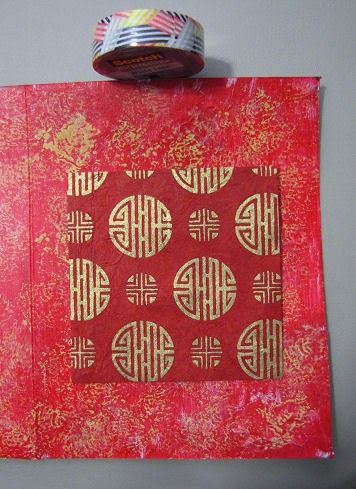

With these brief trials out of the way, I started working with this linocut sample printing from last year. The squares around the outside of the oak leaf square were play areas while the leaf itself would  be practice in applying several colors to dry fabric, then wetting to blend. In this picture I laid down a very light layer of Baked Earth followed by shadings of Poppy Red and highlights of yellow. Not very exciting at this point.


But just add water...and the colors start coming out and blending.


I soon found you can overwork the blending by working with a brush that is too wet. I kept going back in, adding some darker areas with Bark, only to see them fade away. I should have been more patient and waited for the first go round to dry, or use a hair dryer to speed things up, I think. This picture is taken while still wet, and I swear the leaf was lighter when it dried (although I perceived no lightening of the green in the smaller squares). When I flipped it over, I could see where the paint had wicked out about an inch or more underneath the black paint of the stamping. That made me wonder if some of the pigment had actually migrated. You can definitely see the problem with too much water on those center circles.
 
As for my favorite method, I have to thank Margaret Cooter, who has been playing with water soluble graphite pencil, another supply I'll be learning to use in my art journaling. She steered me to this video showing not the typical laying down of graphite followed by a wet brush, but using the wet brush to pick up the graphite directly off the tip of the pencil. Surely this would work with colored pencil too? Yes it does! That is mostly what I used to paint in the green lines. I had more control adding and blending, much less problem with wicking.

I can see that this is not quite as easy as the demos would lead you to believe, that I need to work with this some more to master it, try the textile medium thinned out a bit as suggested. But oh, what an enjoyable couple of hours this was. How will I use it in my art quilts? Not sure, although with resists was the first thing that came to mind. I'll be keeping this latest tool in the back of my mind... 

Thursday, January 15, 2015

What's In Store

A plan of sorts for the year has been emerging. I see 3 areas of focus I wish to concentrate on rather than thinking in terms of individual projects. I'm sure I will bounce back and forth between them, but the strongest one at the moment is the art journaling lessons. All the supplies have arrived and the journal itself is ready to be worked in. I'm partly doing this just for me, for my own enjoyment, but I also hope that some of the lessons learned and materials experimented with will transfer to my fiber art. I can so easily get absorbed in the learning, fascinated with the process and outcome, but then not know what to do with these new "tools in the toolbox." This time, I'm sensing there will be a more direct link between learning and applying.

The second focus comes out of conversations with Michele of Sweet Leaf Notebook. We both enjoyed the challenge we crafted last year, pushing each other to do a different technique on, for me a padfolio, and for her a journal. Our challenge is different from most in that we don't work on the same thing or start from the same place. There's no common theme or technique or piece of fabric that we have to use. No, we craft a personal challenge with the help of each other's observations, questions, encouragement, finding something that feels right at the moment, something we need a push on to get us working on the exploration. Michele thought I should think about thread sketching, perhaps using some of my urban sketches for inspiration. I had to admit, I'd been saving thread sketching articles for years and even tried it once in a journal quilt. The idea of using your sketchbook as inspiration for thread sketched fiber pieces popped up in a lot of places last year, coupled with the idea of coloring them in with paint or colored pencils. The more Michele nudged, the more I started seeing things on thread sketching everywhere I looked. It felt like the perfect storm that I should give in to. So I've taken on the challenge of experimenting with thread sketching which I hope will culminate in a piece that can be part of my ArtWalk exhibit.

And that brings me to my third focus, finishing three new pieces for ArtWalk 2015. I have two on their way - the shibori piece and the fountain wall piece. There's another very near completion that I put aside in 2012 that might be the best choice for number three. I have less than 3 months to have 3 pieces photo-shoot ready to submit with my application. So I must get to work, regardless of what the sirens say. 

I plan to keep my exhibiting to a minimum again this year, so have not thought much about the next art quilts beyond those I'm working on, though I know there are many ideas in the hopper. I'm just not thinking about them right now, although I must admit that my mound of silk ties is begging for my attention. I'll continue with my urban sketching and maybe do more sketching in general as I learn how to use some of the art journaling supplies. No doubt there will be more baskets, a bag or two, and maybe even a dye experiment that's been on my mind. And I must not forget that the nephew's birthday blocks come back to me this year to become a completed quilt for him. And then there's that lap quilt pinned and ready for quilting...

Good thing I've identified 3 main areas of focus! I've already experienced some "spin cycle" moments in the studio.  

Wednesday, January 14, 2015

Taking a Deep Breath...

...or two or three. Just how many deep breaths do I need to take to proceed into the unknown? Quite a few, it would seem, as I check and double check and ponder and research - same old same old for me. At some point, I realize I have to jump in - maybe holding my breath - by making one or two decisions and then I relax and can move forward. Case in point - what to do with the gessoed food boxes when there are so many choices. Well, how about just adding a coat of acrylic paint as step one? I don't have that many colors to choose from, but there I was, dithering anyway. I've probably used the Naphthol red the least, so why not? It reads a beautiful Chinese red to me and was quickly followed by yellow oxide lightened with some titanium white randomly sponged across the surface.


Yowza! I not only love the sponged effect but the yellow reads like gold metallic. My squiggles of paper still are not showing up but I can't say I care much at this point. Viewing this close-up I noticed some of the box graphics do show through even though I thought the red had covered them thoroughly - they are providing that subtle shading layers can give. Thinking to add a bit more in black, maybe just some text, but for the time being, I set it aside.


Food box # 2 is slightly smaller and is not designated for anything yet, so I felt totally at ease experimenting here. Right after publishing that gesso blog post, Joggles.com's mid-week muse video landed in my mailbox - what timing! What Lies Beneath starts out with techniques for gessoed surfaces. I'd seen this stencil demoed in a previous video and fell prey to it. Now was my chance to use it to try out this subtractive method. Basically it's just laying down a thick layer of paint, placing a stencil over it and removing paint through the stencil with baby wipes.


Of course, I hadn't added any color to my gesso as in the video but I thought perhaps some of the color from the box would show through. Only if you look very closely. The brush strokes are also very evident in the gesso now. I think if I do this again, I would lightly sand the gesso. Some of the paint sticks to the stencil when it is removed and I wished that it had done so more evenly. But that's just me. This one will get more layers too.

Forgotten decorative paper stash yields possible addition - and maybe some washi tape along the edges?

While taking my time with the food boxes, I've been considering how to attach my text blocks. I've gone my own way a bit, should be no surprise, in choosing this kind of cover for my Creating at the Speed of Life art journaling exercises, so the book's instructions might need some adjustment. It has you securing the individually sewn signatures together with tape and then wrapping sticky canvas over them for the cover. I could probably attach my cover in a similar way. I consulted other sources and ran across one that suggested sewing the signatures individually with the pamphlet stitch to make them easier to handle when attaching to the cover with the other way I was considering - the long stitch. That made sense to me as the watercolor paper readily available to me was a heavy 140 lb. The more I looked at my food box cover and what else I thought I might want to do to it, the more I thought it might be a bit too fragile to be handled over 30 lessons and that I didn't want to hold up the journaling process while I finished it. I knew I'd be fussing about getting paint on the cover or damaging it, and nearly abandoned the idea of using it for this. But if I sewed together individual signatures to work in and sewed them into the cover once all the lessons were complete - well, that seemed the perfect answer to all my questions and misgivings about my bulky little journal. Now there will be plenty of time to decide how else to embellish the cover.

And so with my mind settled on these little details, there was one more deep breath over hole placement and thread, then go! I sewed the signatures today and am ready to start the lessons anytime. I know, I know - I'm spending too much time getting set up, no doubt. But it's simply not in my nature to just dive into the unknown. I like lots of specific instruction and when they are lacking, I tend to freeze up until I get enough info to make me comfortable. I'm feeling much more comfortable now... 


Friday, January 09, 2015

What's Inside

Here is what got me moving on my recycled box book covers.

For reasons I can't explain, I decided to purchase a kindle version of Pam Carriker's Creating Art at the Speed of LIfe last April. From reviews and a "look inside" I determined it might have more detailed instructions of the art part of art journaling than what I was currently working through which seemed more focused on the journaling part. I think how reasonably priced the kindle version was became the deciding factor. Although I'd bought a mixed media sketchbook early in the year for more extended explorations, I noted that the first thing Pam guides you through is the making of a journal designed to accommodate the exercises in the book. Nice to have that info, I thought, but I really did expect to use that purchased journal. Of course, this was the same time as I was working hard on art quilts for ArtWalk and working through the Positively Creative art journaling exercises, so starting the lessons got put on the back burner. And being on my kindle essentially meant it was out of sight out of mind.

Additional deadlines came and went, summer lured me out of the studio and I became thoroughly entrenched in an epic fantasy trilogy book. Art journaling of all kinds never crossed my mind. By September, I was being drawn back to bookmaking with the urge and need to duplicate a handmade journal like I received in the exchange earlier in the year. With my interest renewed, I was hauling all those bookbinding and journaling books home from the library in late October, being reminded of the recycling of food boxes and setting the first ones aside in November without a clue as to how I'd use them.

Sheets of watercolor paper folded and ready for tearing

November was a funky month for me, full of days when I really didn't have much energy or feel up to par. I got a bug about the book on the kindle though, started reading through instructions and supply lists and now really interested in making my own journal per her instructions. Its finished size was smaller than I expected and a lightbulb went off. Could I use one of those boxes as the cover? Turned out that one of them was about the right size and I couldn't wait to buy some watercolor paper to make the signatures. I got as far as removing the sheets from the pad and making the first fold before the reality of the holidays set in. I can't remember if the gesso was bought before or after the paper, but the only reason I picked it up was to use on those food boxes that would become book covers.

Removing an extra inch by pulling along edge of metal ruler for deckle edge

So this project as been hiding out under my worktable, waiting for me to get back to it. With so many after Christmas sales and blowouts showing up in my mailbox, I decided this might be the perfect time to get out that supply list and see what I needed to buy. At least one thing on the list could be used on fabric, as previous research had informed me, and I could feel that fact pushing me towards a plan of exploration for my fiber art as well. More about all that later. Bottom line, it took a lot of months to get to this point, but slowly things came together and suddenly I felt ready and willing to get going. 

Another method of creating deckle edge with bone folder tearing along fold

And this is how I often end up where I do - taking one bit of an idea that starts to grow as more ideas present themselves, stringing themselves together until I suddenly know what I want to do. What will go inside at least one of the food box covers are these signatures for my art journaling play with Pam.

Weighting signatures

Thursday, January 08, 2015

Gesso

Gesso gesso gesso. Since venturing away from traditional quilting and getting more and more drawn into using paint and art journaling, I'd become aware of gesso but not sure of its use to me. So whenever I see one of my fellow internet artists pull out the gesso, I've taken note. And then one day as I perused the limited art supply section of my local Wal-Mart (American readers, please don't hate me - the nearest real art store is miles away), there sat this bottle of gesso, daring me to take it home. It's unlike me to purchase something like this without a lot of research, so once home with the research beginning, I was relieved that I had bought the right thing.


Yesterday's studio time included getting this gesso out and seeing what it's all about. Several of the bookbinding books I'd gotten from the library last fall talked about recycling food boxes into book covers. These cracker boxes were on their way to the trash when I realized they were a good size for recycling this way. But I didn't want to leave them as is, per some of the instructions, but wanted to cover them over somehow as I'd seen Hilary of Living to work - Working to live blog do in this post. Well, actually nothing that fancy for this first run, but oh, are her handmade books and journals inspiring! I'd read that gesso could do a good beginning cover-up, a priming as it were, for more complete coverage with acrylic paint plus add some tooth to the somewhat slick surface of the box, so that's what I decided to do.


I wasn't sure whether to use a roller or foam brush to apply the gesso, deciding on a 2" foam brush which worked fine. I expected more coverage with one coat but the box graphics still showed through quite boldly (right side of bottom box). I added several more coats, perhaps unnecessarily, but I at the moment think I don't want that showing through whatever I decide to do next. And frankly, I'm not sure what I'm doing next - maybe some stamping or sponging?


Remember the squiggles of release paper I saved from the fused mast reflections of the Sailing the Wine-Dark Seas quilts? I wondered if I could imbed them in the wet gesso rather than using matte medium or glue at a later date. They did not stick well, but I eventually got them flattened into the gesso where I am crossing my fingers they will stay. For the record, I did not like these Nut-Thins so I'd really like to obliterate the image!

I'll talk more about what will go inside at least one of these covers in the next post. In the meantime, I would welcome any advice from my readers with more experience working with gesso and recycled boxes.